


Can You Solve the Murder?
Become the detective in a choose-your-own-story murder mystery
#1 Amazon kindle bestseller
“Sharpen your wits: this clever, intricate book is a highly entertaining mental workout.”
The Guardian
“Incredibly inventive”
Washington Post
“Will delight armchair sleuths of all ages”
Publishers Weekly
“Witty and comprehensive . . . a world of colorful and suspicious characters”
Wall Street Journal
An interactive crime novel in which YOU are the detective. At the end of every chapter, you choose where to go next!
There’s been a murder at Elysium, a wellness retreat set in an English country manor. You arrive to find the body of a local businessman on the lawn – with a rose placed in his mouth. It appears he fell to his death from the balcony above. But that balcony can only be accessed through a locked door, the key is missing, and everyone in Elysium is now a suspect . . .
Gather the evidence and examine the clues. Choose who to interview next, and who to accuse as your prime suspect. But remember that every decision you make has consequences, and some of them will prove fatal . . .
Do you have what it takes? Can YOU solve the murder?







Coming Soon . . .
Can You Solve the Murder?
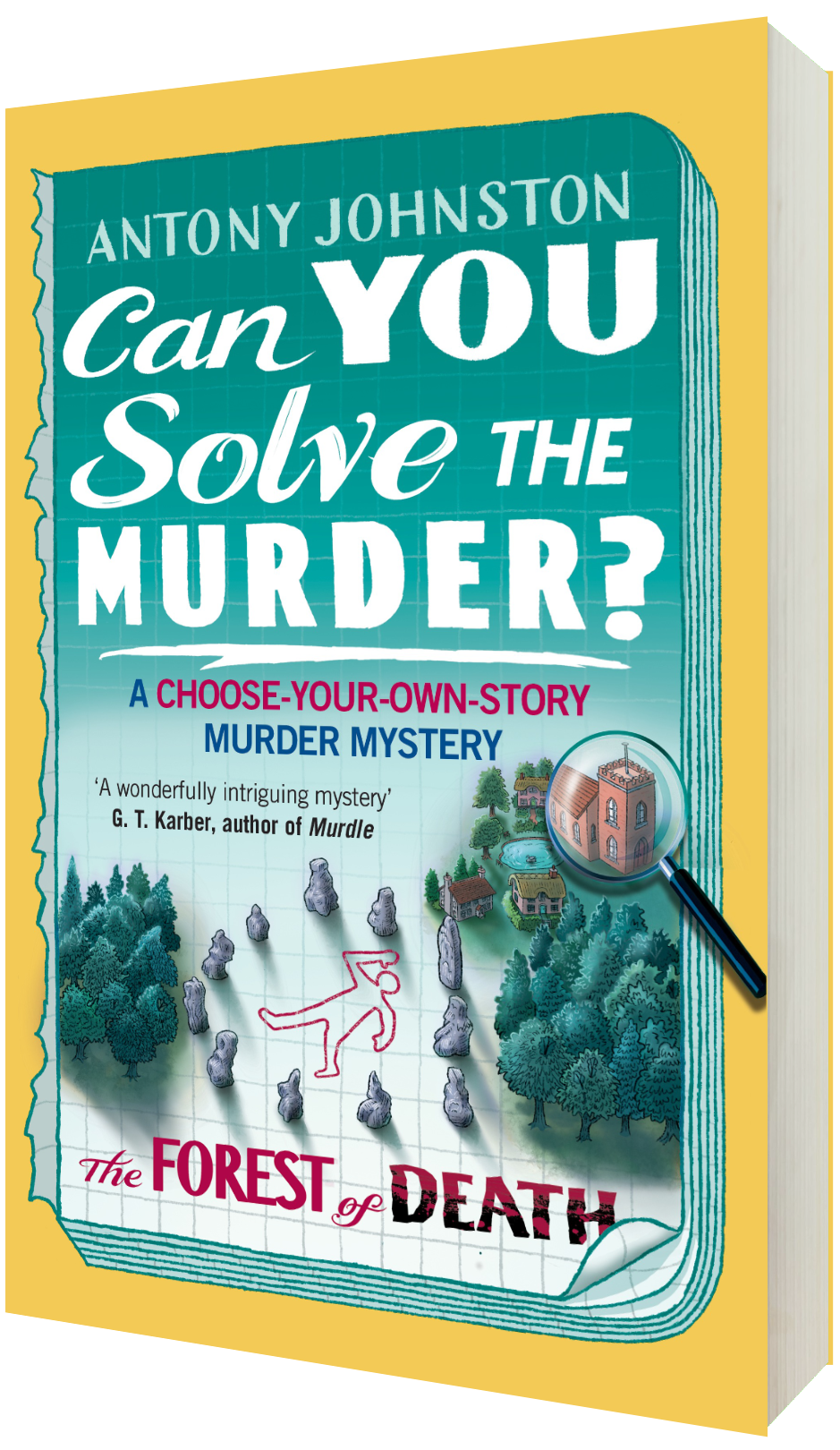
2: The Forest of Death
Another gripping interactive crime novel where YOU are the detective!
A village of secrets.
You arrive at the heart of a remote forest to investigate the murder of a young woman, found dead inside an ancient stone circle. She's a rock singer, who was filming a music video. Now her bandmates are suspects, along with the eccentric locals.
No one is telling the truth.
There's just one problem: they all have water tight alibis, and many villagers believe the singer was actually killed by the ‘Stone Warden’ – a figure from local folklore who haunts the forest.
Only YOU can solve the mystery.
Decide who to interview, decode the strange symbols written on the stone circle, and uncover what the villagers are hiding behind closed doors. Will your choices catch the killer – or will they be your downfall?
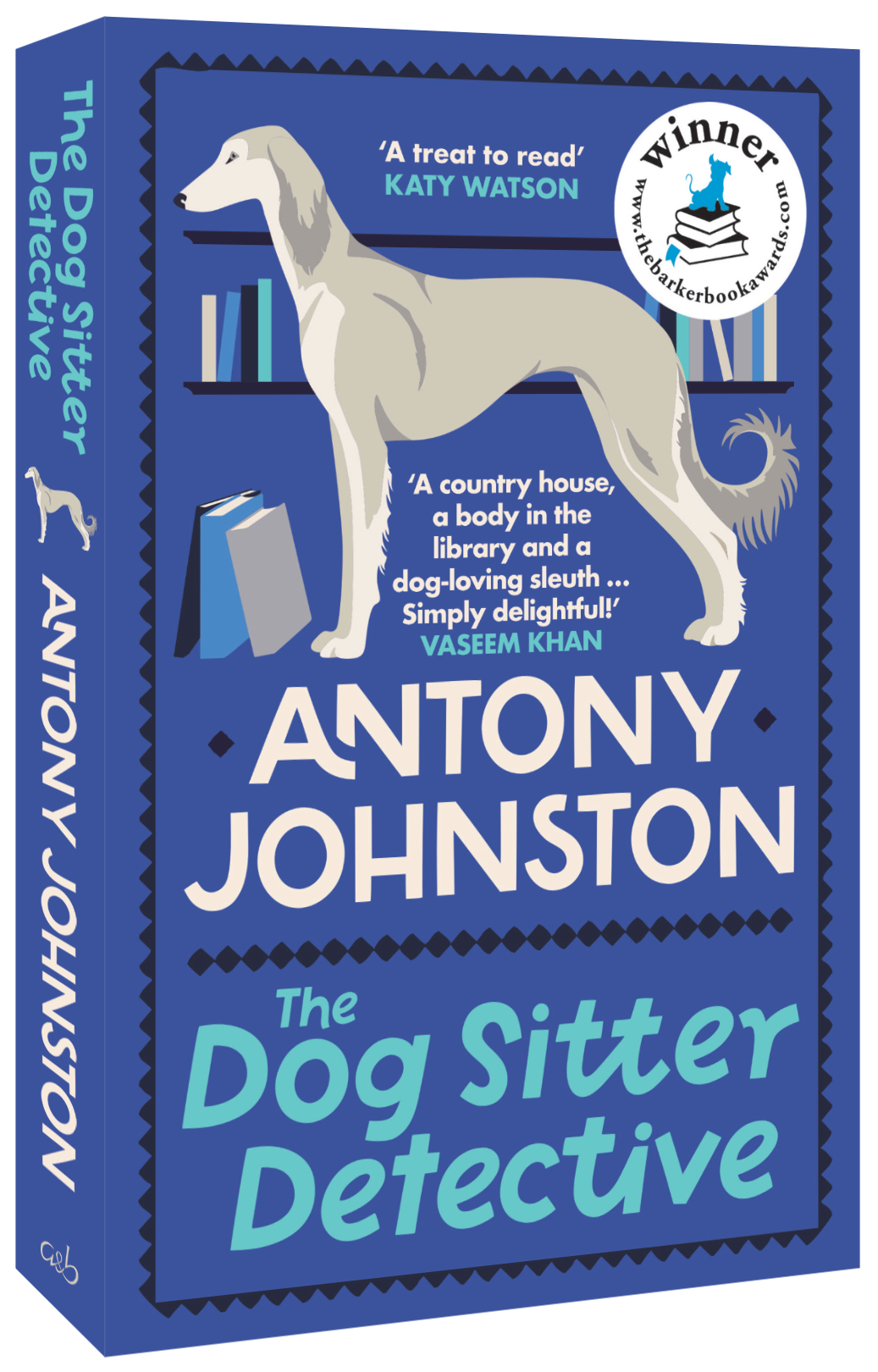
The Dog Sitter Detective
Murder mysteries . . . with dogs!

“A country house, a body in the library, a cast of dodgy wedding guests, and a prickly, dog-loving sleuth . . . Simply delightful!”
Vaseem Khan
Retired actress Guinevere ‘Gwinny’ Tuffel is finding life hard after inheriting her late father's run-down home and discovering she's broke. But Gwinny's delighted to be at her best friend Tina's country house, for Tina's wedding to a handsome Italian business magnate . . . until the husband-to-be is found dead in the library and Tina is accused of the murder.
Convinced of her friend's innocence, Gwinny must piece together the truth and uncover the real killer from a pool of larger-than-life suspects, who all have something to hide . . . while also looking after Tina's expensive saluki dogs!


The Dog Sitter Detective Takes the Lead
Musical murder on the canals of London’s Little Venice
“Warm, witty, and wildly entertaining”
Katy Watson
Gwinny Tuffel is preparing for her first acting role in a decade in the West End, but she is still dog-sitting on the side to keep the wolf from the door. So, when ageing rock star Crash Double needs help with his Border Collie, she jumps at the chance. After all, looking after the charming Ace on Crash's Little Venice houseboat shouldn't be an onerous task. But that's before the singer's dead body surfaces during the annual Canal Carnival festivities.
While the police dismiss the death as an accident, Gwinny suspects murder most foul. With a medley of suspects and some far-fetched motives to make heads or tails of, it is up to Gwinny, with Ace's on the ground knowledge, to make sure the killer faces the music!

The Dog Sitter Detective Plays Dead
A baffling locked-room murder on a Yorkshire film set

“Another fine caper from the master of the genre. I adored it”
Josie Lloyd
Gwinny Tuffel is on location in the misty Yorkshire Dales filming a small part in Draculania, a genderswapped remake of Bram Stoker's classic tale, when life begins to imitate art a little too closely. One of the cast members is found dead inside a locked trailer, with a stake through their heart.
With a prima donna in the starring role, filming is already facing delays, while Gwinny is being run ragged by Lily, the Jack Russell terrier she's looking after for a friend in hospital. Against the backdrop of Hendale Hall with its own vampire legend, a flesh-and-blood killer has struck. Will Gwinny be able to find the murderer before the production or any further victims are cut?

The Dog Sitter Detective’s Christmas Tail
Snowed in with a killer out of the past
“This funny, exciting, charming rollercoaster of a book has it all”
David Quantick
It's almost Christmas and actress and amateur sleuth Gwinny Tuffel is still pondering what to buy DCI Birch (retired) and whether she could adopt a new furry friend. But sorting through her late father's papers leads her into his mysterious past, pointing to an enigmatic 'liaison' now living in a Somerset commune populated by a group of retired spies.
When Gwinny and Birch are unexpectedly snowed in at the remote farmhouse, they find that any skeletons in her father's closet have been joined by a body in the attic. Surrounded by people for whom keeping secrets is second nature, along with an energetic Cocker Spaniel, Gwinny and Birch are embroiled in a murder case once again. Will they uncover the culprit and escape in time for Christmas?
• Visit the website to find out more about the Dog Sitter Detective mysteries
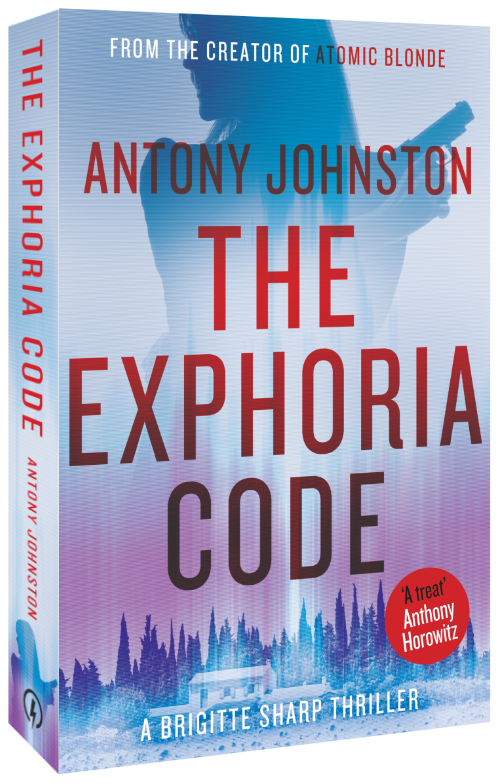
The Exphoria Code
Fast-paced spy thrillers ripped from the headlines
“Possibly the definitive espionage thriller of the early 21st century”
Alan Moore
NEW SPIES. NEW RULES.
MI6 cyber-analyst Brigitte Sharp has been deskbound for three years after her very first field op went badly wrong. But when her best friend is murdered in connection to a series of strange internet posts, Bridge must infiltrate a top secret military project to root out the killer. There she learns that the truth behind the Exphoria code is worse than anyone imagined, and soon Bridge is on the run as a deadly terrorist plot unfolds . . .


The Tempus Project
AI, crypto, and ransomware combine to shatter global politics
“Forget about Lisbeth Salander, here comes Brigitte Sharp. Unputdownable!”
Johana Gustawsson
Bridge is back, to battle a series of hacks and ransomware attacks masterminded by a hacker known only as 'Tempus' who targets politicians and government officials with impunity.
Realising this campaign is linked to a cyber-attack on the London G20 summit, Bridge is drawn into the dark-web world of cryptocurrencies, Russian hackers and an African rebel militia. She must race against time, to prevent a disaster that could alter the balance of global power forever.

The Patrios Network
Online hatred becomes real in neo-fascist Europe
“Contemporary, lightning-paced and in the very top tier of spy fiction. Highly recommended”
MW Craven
When a renegade British officer steals plans for a high-tech weapon that could plunge whole cities into darkness, elite MI6 hacker Brigitte Sharp is sent to get them back. But her mission goes badly wrong.
Meanwhile a 'deepfake' video of a senior US politician calling for race war in Europe sends a flood of Americans to join neofascist militias on the continent. The Russians nurse a ruthless grudge against a fugitive whistleblower. And in the wings, the Chinese flex their muscles. Everything seems connected . . . but how?

• Click here to find out more about the Brigitte Sharp thrillers

The Organised Writer
A productivity guide for writers
“The Marie Kondo of writing”
Linda Stratmann
A productivity system designed for writers, by a writer.
The Organised Writer outlines Antony's own methods and processes for getting work done and juggling multiple projects, using a system he designed himself and continues to employ. Written in a conversational and page-turning style, The Organised Writer is a practical and focused approach to writing for every author who wishes they could take control of their workload.
• Visit the website to find out more about The Organised Writer

Atomic Blonde
The original graphic novel
“Johnston masterfully draws the story to a height, tension and speed rising . . . brilliantly and subtly done”
The AV Club
Originally published as The Coldest City, this is the graphic novel that became a $100 million box-office movie starring Charlize Theron.
November 1989. Communism is collapsing, and the Berlin Wall is about to fall. But first, MI6 officer Lorraine Broughton must retrieve a list of spies before it falls into the wrong hands. She walks into a powderkeg of social unrest, counter-espionage, defections gone bad and secret assassinations . . . and nothing is what it seems.
• Click here for more about Atomic Blonde
More Writing & Other Work
Are you looking for Antony’s work in videogames, graphic novels, film, and more? Check out the work index page.